bio-m®
Agitator Technology
The Heart of Your Process Vessel
The agitator is the pulse of your process vessel. In sterile applications, it is the single most critical component for product quality and batch consistency. There is no room for compromise here.
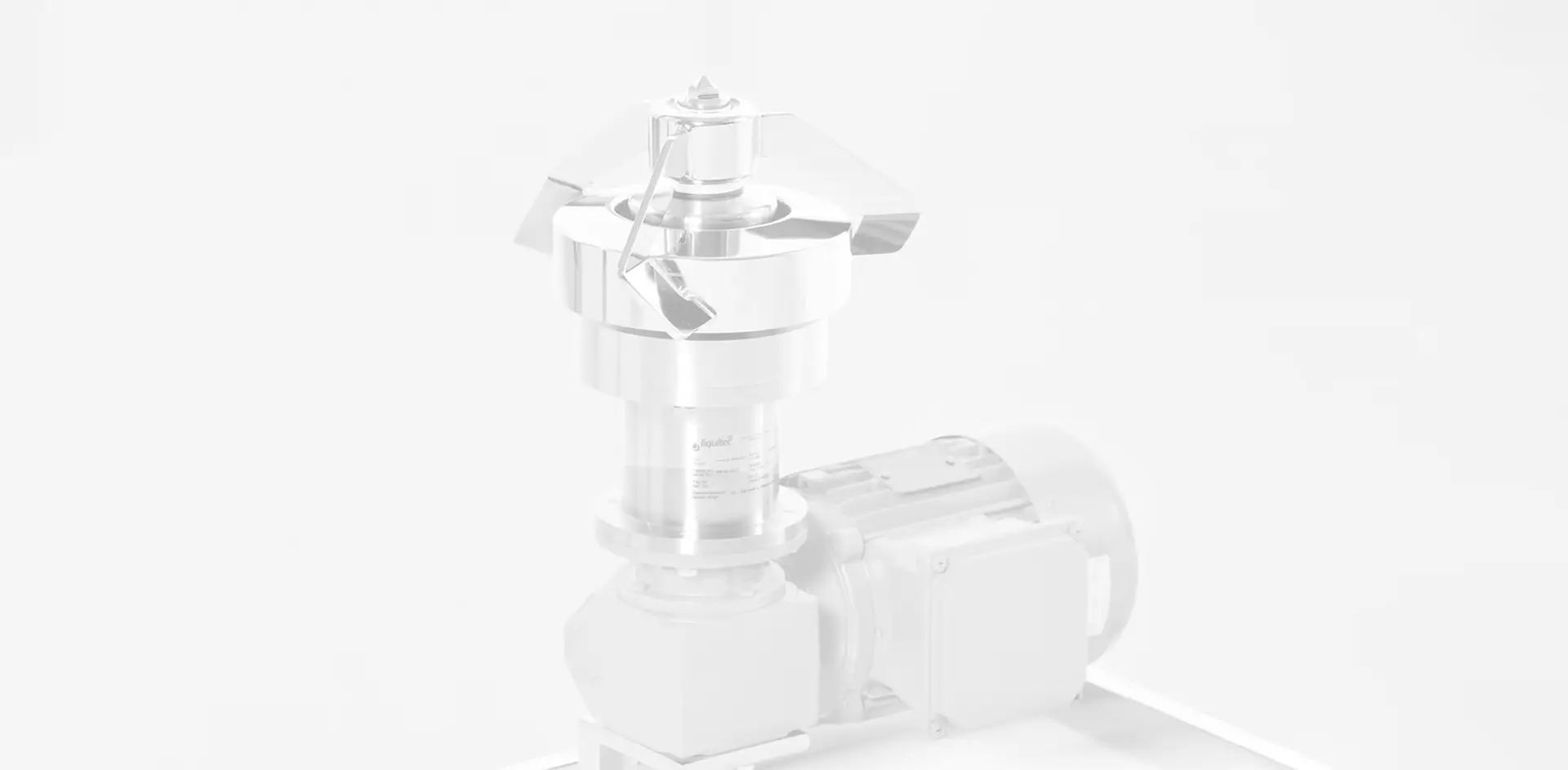
Agitators
The Heart of Your Process Vessel
The agitator is the pulse of your process vessel. In sterile applications, it is the single most critical component for product quality and batch consistency. There is no room for compromise here.
At liquitec, we understand that a reliable process requires a reliable origin. That is why we do not outsource the heart of your machine. Operating from our two high-tech production sites in Kirchberg (BE) and Wil (ZH), we manufacture all wetted parts in-house.
This deep vertical integration is the foundation of our Strategic Agility. We do not rely on global supply chains for critical components; instead, we maintain a substantial stock of semi-finished parts, ready for the final steps of customization. This anticipation allows us to bond our manufacturing strengths directly to your process needs: gapless traceability, perfect surface finishes, and adherence to timelines that others cannot match.

Magnetic Agitator Advantages
The Logic of Containment
Protect the Precious & Potent Your ingredients are often too potent to risk exposure or too precious to allow a leak. In modern biotech, there is no margin for batch loss. By replacing the mechanical seal with a hermetic magnetic coupling, we guarantee a closed system. Zero leakage means zero risk to your staff and zero loss of your high-value product.
Eliminating the Cost of Friction Mechanical seals represent a maintenance liability and an energy inefficiency due to friction. bio-m® Magnetic Agitators eliminate this overhead entirely. With no friction losses, no barrier fluids, and no scheduled maintenance breaks, you receive pure mixing power rather than heat generation and operational costs.
Liquitecs Advantages
The Definition of Swiss Precision
Machined from Blocks, Not Sheet Metal We strictly utilize subtractive manufacturing from solid stainless steel blocks. This approach eliminates unnecessary welding spots and guarantees structural integrity. It allows us to machine the tightest clearances and minimize air pockets to absolute zero, ensuring the best cleanability in the industry.
Hygiene at the Core (EHEDG) Hygienic design is not just a standard we follow; it is our mindset. Designing with EHEDG guidelines at the core, we achieve surface finishes of Ra < 0.4 μm as our standard. We obsess over details to ensure your vessel remains sterile, with 100% gapless traceability kept strictly in-house.
Precision Beyond the Catalog We do not believe that a standard catalog product is always enough for critical processes. We refuse to serve 100% of the market with 20% of the equipment. We design the agitator to fit your specific needs—adapting geometry and tolerances to your vessel—with no compromises. Just fit for purpose.
Mixing Tasks
Mastering the Physics of Your Process
Every process has a dominant physical challenge. We don't just stir liquids; we engineer the flow pattern to conquer that specific challenge.
- The Task: Achieving rapid uniformity of miscible liquids, often with different densities or viscosities (e.g., Buffer Prep, Media mixing).
- The Liquitec Strongsuit: Digital Verification (CFD).
We don't guess your mixing time. For critical blending tasks, we can simulate the process using Computational Fluid Dynamics to guarantee homogeneity is reached before the first batch is ever run.
- The Task: Maximizing the exchange of thermal energy between the product and the vessel jacket (Heating or Cooling).
-
The Liquitec Strongsuit: Wall-Flow Geometry.
Standard agitators leave valuable solids trapped in the dead volume. Our Lean Bottom System (LBS) and low-level impellers are engineered to keep solids suspended down to the absolute last liter, maximizing your yield recovery.
- The Task: Keeping insoluble particles (crystals, catalysts, or precipitates) in motion to prevent sedimentation at the vessel bottom.
- The Liquitec Strongsuit: The Lean Bottom Advantage.
Heat transfer relies on breaking the thermal boundary layer at the tank wall. We position our impellers and design the flow turbulence to constantly renew the liquid at the jacket surface, ensuring rapid heating/cooling without local overheating.
- The Task: Breaking down liquid droplets or dissolving difficult powders into a continuous phase (e.g., Oil/Water emulsions).
- The Liquitec Strongsuit: High-Shear Options (Rotek & Rotor-Stator).
Standard magnetic mixers often lack the torque for this. We defy the norm by offering high-energy Rotek and Rotor-Stator magnetic heads that deliver the shear rates of a homogenizer with the hermetic safety of a magnetic drive.
- The Task: Gentle movement of sensitive cell cultures or microbial fermentation requiring high Oxygen Transfer Rates (KLa).
- The Liquitec Strongsuit: The BMAF Stability.
Bioreactors often require deep vessels and long shafts. Unlike competitors who struggle with wobble, our BMAF features a reinforced ceramic bearing unit that stabilizes long shafts, ensuring efficient gas distribution without damaging shear-sensitive cells.
More About Agitation
Engineering Out the Risk
The Billion-Dollar Lesson The North American Mixing Forum estimates that poor mixing costs the process industry between $1 and $10 billion annually in lost yield and wasted energy. Most of these losses occur because mixing was treated as an afterthought. You have the power to avoid this statistic in your new plan.
Solving Symptoms at the Source We often see operators resigned to living with inconsistent batch times, local overheating, or sedimentation. These are not "process realities"; they are physics problems that can be calculated and solved. You do not have to accept a design that forces you to compromise later.
The Solution is Conversation If you are in the planning phase, you have a unique opportunity. By bringing Liquitec to the table before the steel is cut, we can simulate the flow and guarantee the outcome. We bridge the gap between your deep product knowledge and our hydrodynamic expertise to ensure your new vessel performs perfectly from Batch #1.
Contact us
Engineering First Sales Second
No Strings. Just Physics. Do you have a specific worry about your current process? Or perhaps just a rough sketch for a future project? You don't need a finished specification to talk to us. In fact, the earlier we speak, the more we can help.
Get a Sanity Check. Our engineers are here to act as a sounding board. Whether you need to validate a calculation, troubleshoot a "symptom," or simply ask if a magnetic agitator is right for your medium—we are ready to help. No pressure. No strings attached. Just an honest engineering opinion.
The Profit Center
Don't Leave Money in the Tank
In high-value pharmaceutical processing, the most expensive volume is the "Heel"—the product left behind because standard agitators cannot mix the final liters. Conventional design forces you to write off this residual volume as unavoidable waste.
We disagree. Leaving active ingredient in the tank every single batch is not a "process reality"; it is money left on the table. In this case in the tank.
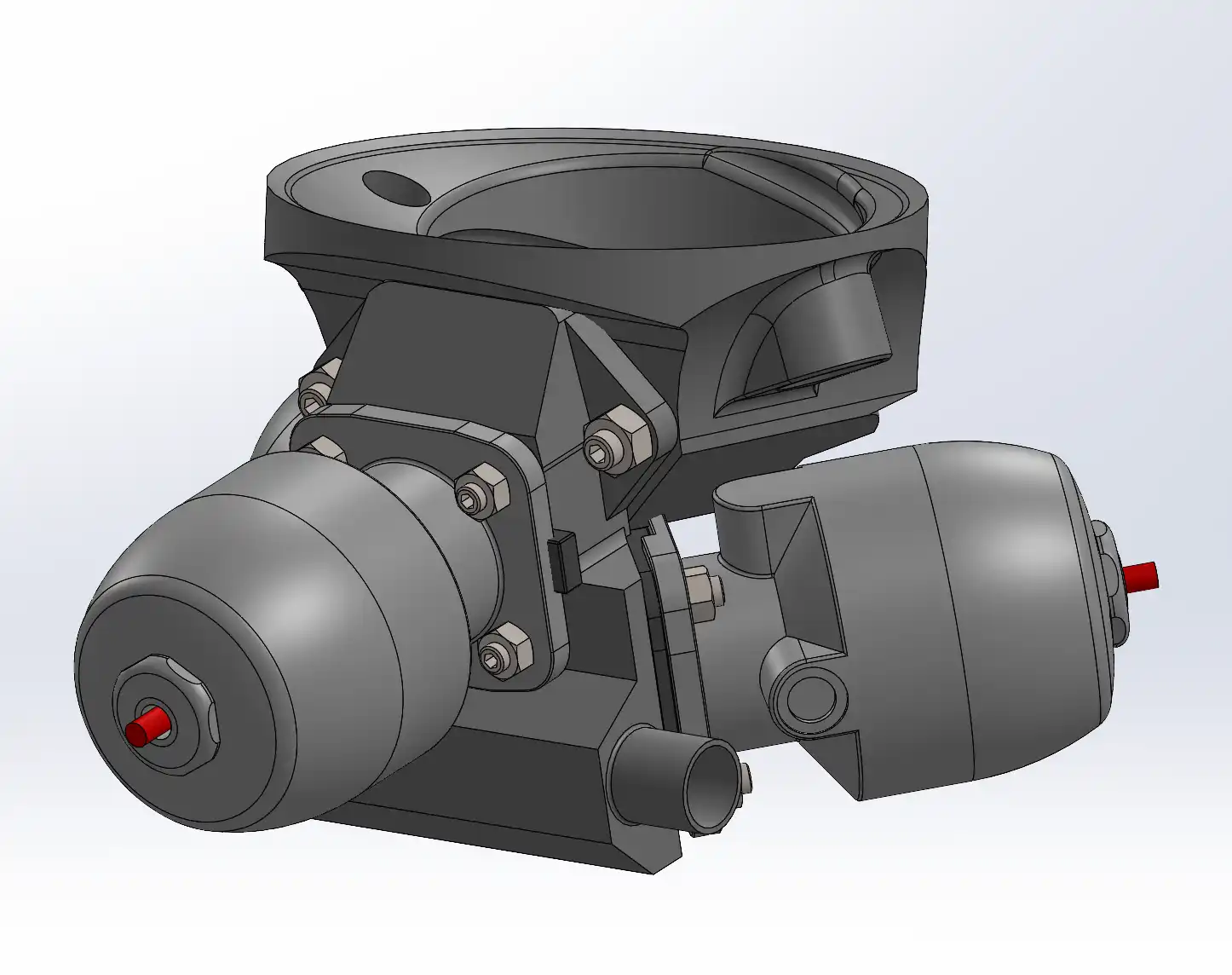
The bio-m® Lean Bottom System (LBS) reverses this logic. We have engineered the vessel floor as a single symbiotic unit—integrating the agitator, the bottom outlet valve, and up to two Ingold ports into one pre-fabricated block
For your Vessel Builder, this eliminates complex welding work and validation risks. But for you, the Process Owner, it delivers the ultimate return: full homogeneity and drainability down to the absolute last drop. You recover almost 100% of your valid product, every single batch
Advantages
Designed for the Owner. Loved by the Builder
Yield loss is often viewed in isolation, but in a multi-stage pharma process, it compounds.
- The Problem : Standard agitators stop mixing once the level drops below the blade, forcing you to discard the "heel" volume. In a 3-stage process train, this can waste almost 30% of the batch or in 500 liters you lose almost 140 liters.
- LBS Solution : Our deep-set impeller maintains full turbulent flow and homogeneity down to the absolute last drop. You recover almost 100% of your valid product, every single batch. In a couple of batches, this system pays for itself in recovered yield alone.
There is a difference between "moving" liquid and "mixing" it. Standard magnetic mixers lose their mixing vector at low levels, leading to stratification (separation of ingredients). The LBS ensures that even the final liter of product exiting the tank is perfectly homogenous, ensuring your fill-finish quality is consistent from start to finish.
In sterile processing, a piping intersection is a risk. A "dead leg" is a biological incubation zone.
- The Liquitec Standard : We engineered the LBS valve block to exclude dead legs completely. The flow path is flush, fully drainable, fully cleanable, and actively swept by the mixer.
-
The Result : You eliminate the primary source of cross-contamination between batches. Your cleaning validation becomes simpler, and your patient safety margin increases.
We make it easy for your vessel manufacturer to give you a perfect tank
- The Reality : Welding multiple flanges (Mixer, Valve, Drain, Sensors) into a dished bottom causes heat distortion, warping, and polishing headaches.
- The Advantage : By delivering the LBS as a single, pre-fabricated Multi-Port Master Flange, we reduce your tank builder's welding work substantially. This minimizes the risk of vessel warping and ensures your critical bottom geometry is factory-perfect before it even arrives at your site.
Options
Configuration & Sizing (Standalone vs Paired)
We adapt the LBS strategy to your vessel scale.
Standalone Configuration
For smaller vessels, the LBS acts as the sole mixing unit (optimized for 60L – 250L working volumes).
Paired Configuration (Hybrid)
For large process vessels, the LBS works in tandem with a main agitator. We optimize the LBS geometry to handle the "heel" volume, ensuring homogeneity down to the last drop after the main agitator has stopped.
Questionnaire
Valve System Configuration
Choose the level of hygiene that fits your risk profile. Both options utilize our proprietary zero-dead-leg flange design.
Standard Bottom Membrane Valve
The essential solution for fully drainable harvesting. Ideal for standard media or buffers where active valve sterilization between steps is not required.
Valve Cleaning System (VCS)
The advanced solution for high-potency or sterile critical applications. This configuration includes an integrated Rinsing Valve Port, allowing cleaning agents (CIP) and steam (SIP) to actively flush the valve body. This eliminates potential residue traps, ensuring the outlet is as sterile as the vessel itself.
Freedom of Automation
We believe in open architecture.
Your Choice
You are free to select the valve actuator brand (e.g., your site standard) to ensure seamless integration into your existing automation grid.
Our Guarantee
Regardless of the actuator brand, we handle the mechanical integration. We guarantee a dead-leg-free connection between the actuator and the valve block, ensuring that your choice of automation never compromises process stability or hygienic design.
The Integral (F5 - Removable Unit)
A fully removable flange assembly. It allows for the extraction of the entire agitator unit from the tank bottom, offering total maintenance freedom without ever breaching the vessel top.
One System. One ATEX Certificate
Stop chasing individual certificates. We certify the entire functional unit—the LBS body, the Agitator, the Valve body, and the Actuators—under a single ATEX system certification (Zone 1 or Zone 2).
The Benefit
Drastically reduced documentation workload. You receive one dossier for the whole assembly.
Materials & Surface Quality Standard
Stainless Steel 1.4435 (BN2), Surface Finish Ra < 0.4 µm (Grinded).
High-Spec
Electropolished surfaces and exotic alloys (e.g., Hastelloy) are available upon request for corrosive media.
Digital Process Verification (CFD)
You can add a Computational Fluid Dynamics (CFD) study to your LBS package. We simulate your specific medium and tank geometry to visualize mixing times and shear rates before we cut the steel.
The Sterile Standard. Absolute Containment. Zero Compromise
In sterile processing, the greatest threat to your batch comes from the outside world. Traditional mechanical seals are dynamic barriers; they wear, they require barrier fluids, and ultimately, they represent a "managed risk" of contamination.
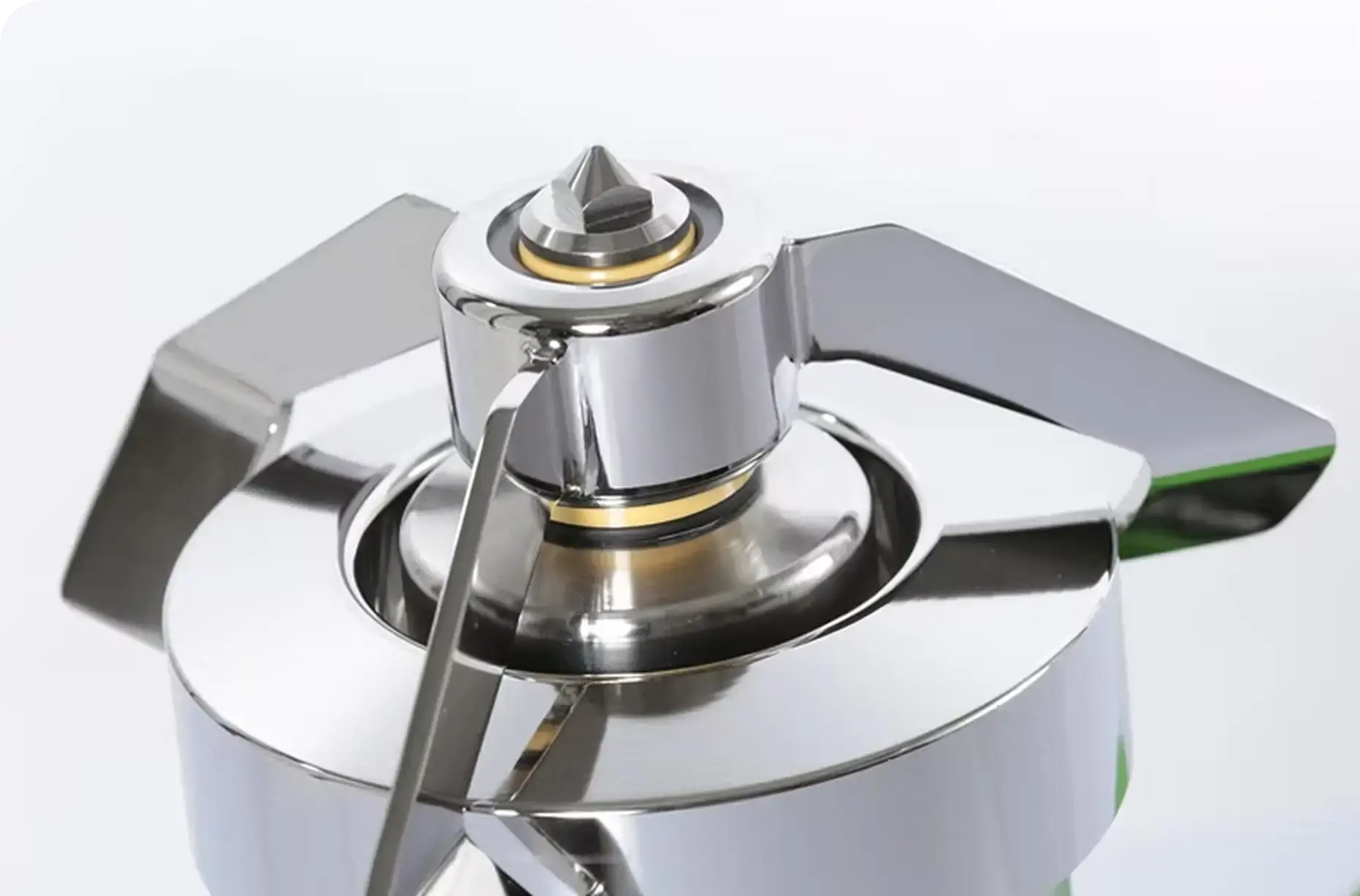
The bio-m® BMA (Bottom Magnetic Agitator) removes this risk entirely. By replacing the physical shaft entry with a hermetic magnetic coupling, we create a closed system that is physically incapable of leaking.
This is the "Daily Driver" of the modern pharmaceutical industry. Scalable from 2L pilot vessels up to 150,000L industrial tanks, the BMA delivers the torque and mechanical authority of a traditional shaft mixer, but with the absolute sterility of a magnetic drive. It is the default choice for 90% of critical applications where batch loss is not an option.
Advantages
The Engineering Standard
Internal destructive testing has confirmed that the standard bio-m® bearing system withstands dry-running for over 100 minutes before mechanical seizure. While dry operation is outside standard operating procedures, this significant safety buffer protects the asset against accidental startups or drainage errors, ensuring robust performance under real-world conditions.
We design for longevity rather than replacement. Although the Zirconia (ZrO2) and Silicon Carbide (SSiC) bearing surfaces are engineered for long-term wear resistance, the outer bearing assembly remains fully accessible and replaceable on-site. This maintainability ensures the agitator remains a viable, high-performance asset for the lifespan of the vessel.
For critical GMP applications, process validation requires absolute certainty. Our optional Speed Sensor Unit utilizes a Hall effect sensor to detect a trigger magnet located inside the impeller, providing a true confirmation of rotation. This distinguishes the system from standard drive-shaft measurements, ensuring the automation system receives verified feedback from inside the tank.
To eliminate the risk of coating detachment or particulate generation, we utilize solid ceramic bearing materials rather than surface-coated alternatives (such as DLC Diamond-like coatings). A study by the ZHAW - Zurich University of Applied Sciences confirms that our specific Zirconia/SSiC tribology generates no detectable particulates, ensuring the sterile integrity of the product is never compromised by the equipment materials.
A critical design parameter in magnetic mixing is the gap between the drive magnet (can) and the impeller. We prioritize hygienic performance by engineering a widened gap that maximizes fluid flow and CIP efficiency behind the impeller. High-grade magnetic materials are utilized to maintain full torque transmission without compromising this essential cleaning clearance.
To prevent "thermal breathing"—the creation of non-sterile voids during temperature cycling (SIP)—we match the thermal expansion coefficient of our Zirconia female bearings to that of the stainless steel housing. This material compatibility allows for high-precision fits that ensure a almost gapless air pocket, bacteria-tight construction.
As a manufacturer with full control over our production chain, Liquitec retains the flexibility to adapt standard designs to specific project constraints. We view non-standard requirements—such as specific shaft lengths or flange adaptations—as engineering parameters rather than obstacles. This vertical integration allows us to deliver customized, high-precision solutions with the reliability of a standard product.
Options
Solving the Access Problem
The interface between the tank and the agitator is not just about containment; it is about accessibility. We offer solutions that eliminate the need for dangerous tank entry:
The Hermetic Standard (F1 - Weld-In Can)
The default for maximum containment. The shell is welded directly into the vessel bottom
The Serviceable (F2 - Plug-In Can)
Ideal for vessels too small to enter (no hand-hole access) or too large for safe technician entry. This design allows you to remove the containment shell and service the bearing seals entirely from the outside, eliminating confined space risks.
The Integral (F5 - Removable Unit)
A fully removable flange assembly. It allows for the extraction of the entire agitator unit from the tank bottom, offering total maintenance freedom without ever breaching the vessel top.
Questionnaire
Magnetic Safety Systems (Decoupling)
Handling powerful magnetic drives carries risks. We offer engineering solutions to protect your team and plant
Standard (BMA 4000+)
Large units come standard with a Driver Magnet Descent System. This mechanism creates a "magnetic break," allowing the safe, controlled lowering of the drive magnet away from the vessel to prevent injury or equipment damage.
Optional (Up to BMA 2500)
For smaller and medium sizes using the Bayonet System, the descent mechanism is available as an option. It adds an extra layer of safety for operators decoupling the drive unit during maintenance.
A Consequence of Your Process
We supply the torque your infrastructure demands. Beyond standard AC drives, we offer specialized options.
Pneumatic Drives
Available for environments where compressed air is the preferred power source or for specific explosion-proof requirements.
DC Motors
High-efficiency direct current options for specific pilot or portable skid applications.
Hygiene Zones
Stainless steel encapsulated motors for wash-down areas.
The Right Tool for the Job
We invite you to consult with our engineering team to select the exact geometry for your rheology. Our portfolio includes:
bio-m Standard (ST1)
The universal solution for mixing and heat transfer.
Marine Propeller (MP)
For gentle axial flow and cell culture applications.
Rotek (RT)
Medium shear force for faster buffer preparation.
Rotor Stator (RS)
High shear force for dispersion and emulsification.
Dissolver (DS)
Saw-tooth geometry for cutting and dissolving solids.
High Efficiency (HER)
Optimized for maximum flow with minimum energy input.
Materials & Alloys Standard: 1.4435 (AISI 316L)
Exotic Options
For corrosive media, we manufacture in Hastelloy C22 (2.4602), 1.4539 (904L), or Duplex among others. If your process chemistry requires it, we can build it.
Engineered for Growth
Your Biology, Our Physics
Fermentation is not just Mixing. It is the precise control of the micro-environment. Whether you are running an aggressive aerobic process requiring high gas dispersion rates or a strictly anaerobic cultivation demanding perfect homogeneity, the bio-m® BMAF Series is the chassis upon which your process stability rests.
From Pilot to Industrial Production. We scale with your biology. The series spans from the BMAF 30 (Pilot Scale) to the massive BMAF 20,000 (Industrial Scale).
We Don't Guess. We Calculate. In fermentation, "off-the-shelf" is a risk you cannot afford. Fit-for-purpose optimization is always included in our scope. Every BMAF project begins with pre-engineering advice. We analyze your specific rheology, gassing rates (vvm), and shear sensitivity to design the exact shaft length, impeller spacing, and hub connection required to maximize your yield.
Advantages
Precision Over Power
In fermentation, standard dimensioning provides a safety baseline, but it rarely achieves peak efficiency. We take the engineering further.
By fine-tuning the complete range of agitator parameters—from geometry to positioning—we align the equipment perfectly with your specific process dynamics.
- The Value : This subtle optimization yields superior performance on what matters most: your biological yield. It often allows us to achieve these results with a leaner, more efficient drive configuration, reducing your energy footprint and capital expenditure without compromising process capability
Fermentation involves long shafts operating in demanding, high-turbulence environments. In these high-aspect-ratio vessels, stability is the prerequisite for performance.
- The Liquitec Standard : We ensure operational smoothness through calculation, not estimation. For every BMAF, we model the critical speed thresholds relative to the shaft dimensions and bearing reinforcement.
- The Result : Uncompromising rotational stability. We deliver energy to the fluid, ensuring that the mechanical seal and tank floor are protected from vibration, even during aggressive agitation.
The interface between the shaft and the impeller is critical for both sterility and mechanics. We offer two definitive solutions based on your operational philosophy.
- The Permanent Solution (N5 - Welded Hub) : The impeller is fully welded to the shaft2. This creates a single, continuous stainless steel unit with zero crevices, offering the ultimate hygienic standard for dedicated GMP processes.
- The Flexible Precision (N2 - Sealed Slide Hub) : A precision-engineered peel-on connection sealed with O-rings. This design utilizes a tight tolerance fit for mechanical rigidity while ensuring a verified sterile boundary. It offers the ideal balance: the flexibility to reconfigure impellers on demand without compromising hygienic integrity.
In aerobic processes, gas introduction changes the fluid density, creating resistance that challenges standard magnetic couplings.
- The Calculated Solution : We address this physics challenge with precision. By calculating the exact torque curve required for your maximum aeration rates, the BMAF delivers uninterruptible torque transmission. We ensure that your mass transfer KLa is limited only by your biology, never by the capability of the drive train.
Options
Beyond the Standard
We do not force your biology to adapt to a limited catalog. We offer a comprehensive suite of impeller geometries, each engineered for a specific rheological purpose.
Gas Dispersion (High Mass Transfer)
For aggressive aeration, we deploy the Rushton Turbine (RT) or the Hollow Blade (HB). These radial flow masters are designed to shear gas bubbles into micro-bubbles, maximizing the interfacial surface area for oxygen transfer.
Axial Flow & Homogeneity
To conquer stratification in tall tanks, we utilize the Hydrofoil Propeller (TR) or our High Efficiency Impeller (HEI). These generate powerful top-to-bottom turnover with minimal power consumption
Gentle Cultivation
For shear-sensitive cell lines, the Marine Propeller (MP) or Segment Impeller (SR) provides the necessary suspension with the lowest possible hydromechanical stress.
Universal Mixing
The Pitched Blade Impeller (SBR) remains a robust workhorse for general mixing tasks.
Questionnaire
Digital Verification (CFD)
For critical investments, hope is not a strategy. We offer Computational Fluid Dynamics (CFD) simulation as an optional service. Before steel is cut, we simulate the flow patterns, shear gradients, and mixing times inside your specific vessel geometry. This digital twin validates your design, ensuring that the hardware we build will perform exactly as predicted.
Surface Perfection as Standard
In a bioreactor, the surface is part of the sterile barrier. We standardize on excellence. Our default offering for wetted parts is a surface roughness of Ra < 0.4 µm, finished with Electropolishing (E2). This ultra-smooth profile minimizes biofilm adhesion and maximizes corrosion resistance, ensuring your CIP cycles are effective every time.
Comprehensive Validation
We deliver more than a machine; we deliver a compliant component of your GMP audit trail. Every BMAF comes with a complete validation package, including:
- Material Certificates (3.1) for all product-contact parts
- Certified Surface Roughness Reports
- Delta Ferrite Content Verification
- FDA / USP Class VI compliance for all seals.
Defined by Access
We align the mechanical interface with your maintenance philosophy.
The Hermetic Standard (F1 - Weld-In Can)
The containment shell is welded directly into the vessel bottom. Zero gaskets, zero crevices—the permanent choice for dedicated lines.
The Serviceable (F2 - Plug-In Can)
Ideal for vessels without hand-hole access. This design allows the containment shell to be removed from the outside, permitting seal maintenance without ever breaching the sterile tank boundary.
Solving the Geometric Puzzle
When Bottom-Entry is Not an Option
The Exception to the Rule. At Liquitec, we believe the bottom-mounted magnetic agitator is the gold standard for sterile mixing. It is the most hygienic, stable, and ergonomic solution for 90% of pharmaceutical applications. However, process reality does not always follow the rules.
Engineered for Constraints. When your tank geometry, complex piping layout, or specific process chemistry makes a bottom entry impossible, we deploy our Top-Mounted Series. We do not position this as a competitor to our standard BMA line, but as a specialized, high-performance tool for specific engineering challenges. Whether you are retrofitting a legacy vessel or designing a skid with zero ground clearance, the Top-Mounted series brings hermetic magnetic safety to the top flange.
Advantages
Engineered for the Exception
In processes requiring absolute drainage or complex bottom piping, a bottom-mounted mixer can be a physical obstacle.
- The Constraint: Bottom magnets and their weld-in flanges occupy valuable space on the tank floor and can interfere with drain valves or sumps in small vessels.
- The Solution: The TMA moves the drive train to the roof. This leaves the tank bottom completely free, allowing for optimized, center-drain geometries and simplifying the layout of harvest piping.
In crystallization or suspension processes, heavy solids settle and pack at the tank bottom.
- The Risk: Starting a bottom-mounted mixer while the bearing is buried in abrasive "sludge" can lead to rapid ceramic wear or failure.
- The Solution: With a Top-Mounted drive, the bearings are located safely in the headspace, far from the sediment zone. The impeller hangs down and, upon startup, lifts the solids away from the floor without the bearing ever grinding against the particulates.
The industry is filled with legacy vessels operating with leaking mechanical seals on top flanges.
- The Challenge: Cutting a hole in the bottom of a certified pressure vessel to install a bottom mixer is often a regulatory and financial impossibility.
- The Fix: We engineer magnetic drive units that fit your existing DIN or ANSI top flange patterns. This allows you to upgrade from a mechanical seal to a hermetic magnetic drive using the existing vessel interface—preserving your tank's pressure certification.
Top-mounting a magnetic shaft without a bottom support introduces specific physics: deflection and thermal expansion.
- The Liquitec Standard: We calculate the critical speed and shaft diameter for every unit. We are transparent about the limits: without a Lower Bearing Support (LBS), the shaft length is physically limited by the critical speed. We engineer within these safe limits to ensure the shaft remains stable without whipping.
Options
Power Density (Torque Range)
We size the magnetic coupling to the viscosity and volume of your specific process, ensuring you never pay for unneeded weight on your top flange.
- The Range: From micro-scale 30 Ncm drives for pilot reactors up to 2,500 Ncm for industrial blending.
- The Benefit: This wide granularity allows us to match the drive train to the shaft length, minimizing the "pendulum weight" on the top nozzle.
Questionnaire
The Interface: Plug-In Simplicity
We have standardized the most versatile interface for top-mounted applications.
- The Solution (F2 - Plug-In Can): Our standard design utilizes a Plug-In Containment Shell.
- The Advantage: This design allows the hermetic shell to be inserted through the nozzle and bolted to the existing DIN or ANSI flange. It eliminates the need for welding, making it the perfect "Drop-In" retrofit for upgrading legacy vessels from mechanical seals to magnetic drives.
Impeller & Connection Logic
We adapt the mixing element to the process goal, but mechanics dictates the assembly.
- The Geometry: Whether you require Low-Shear Suspension (Marine Propeller) or Gas Dispersion (Rushton Turbine), we calculate the optimal impeller diameter based on your process data.
- The Connection: The method of attaching the impeller to the shaft (Welded vs. Detachable) is not a simple catalog choice. It is strictly limited by the shaft dimensions and the nozzle diameter. Our engineering team determines the viable connection type to ensure mechanical stability and installation feasibility.
Drive Technology (The Headroom Solvers)
When top-mounting, vertical clearance is often the enemy. We offer a range of drive architectures to solve your specific layout constraints:
- Low-Profile Solutions: For skids with limited ceiling height, we can deploy compact planetary gear systems that significantly reduce the vertical footprint compared to standard worm gears.
- Cleanroom & Safety: For open cleanrooms or hazardous zones, we configure the drive with Stainless Steel housings or Pneumatic motors for explosion-proof safety. Consult our engineering team to define the exact drive architecture for your zone.
Surface Perfection as Standard
Because top-mounted shafts are difficult to inspect manually, the surface finish must be flawless.
- The Standard: We do not compromise on the finish. All wetted parts are supplied with a surface roughness of Ra < 0.4 µm, finished with Electropolishing (E2). This ensures maximum cleanability and corrosion resistance for the long, suspended shaft.
Continuous Homogeneity
Passive Efficiency or Active Control
The Inline Philosophy. Not all mixing happens in a tank. For continuous processes, dosing loops, or rapid heating, mixing must occur directly in the pipe. Liquitec offers two distinct technologies to achieve homogeneity "on the fly".
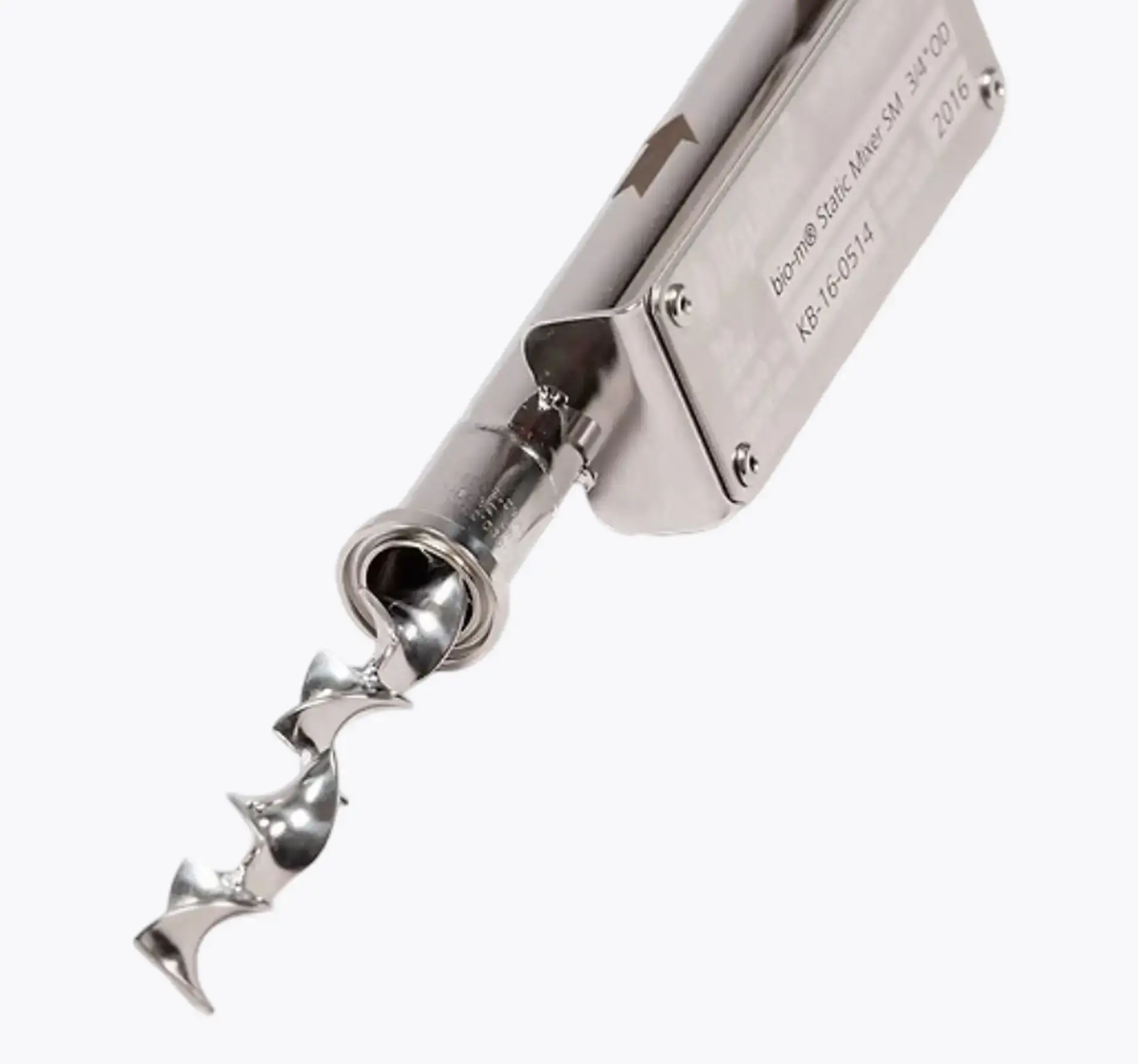
- The Passive Path (bio-m® SM): A static mixing solution that utilizes the flow energy of the fluid itself. Zero moving parts, zero maintenance, and absolute reproducibility.
- The Active Path (bio-m® Dynamic): A motorized inline mixer for applications requiring defined shear forces independent of the flow rate. Ideal for emulsions and dispersions where mechanical energy is required to stabilize the product.
Advantages
The Right Energy for the Mix
The bio-m® SM relies on helical mixing elements to repeatedly divide and recombine the flow stream.
- Zero Maintenance: With no moving parts and no mechanical seals, the static mixer is the most reliable component in your line. It never leaks, never fails, and requires no spare parts.
- Hygienic Design: The mixing elements are housed in a sanitary tube with surface finishes of Ra < 0.8 µm (standard) or Ra < 0.6 µm (electropolished). The element can be easily removed for inspection, or cleaned in place (CIP) with no shadow zones.
- Defined Residence Time: Unlike a tank where some fluid circulates longer than others, the static mixer ensures every drop of product experiences exactly the same mixing history.
Sometimes, flow energy isn't enough.
- Shear vs. Flow: In a static mixer, mixing energy depends on how fast you pump. In the bio-m® Dynamic, we decouple this. You can run a low flow rate but spin the mixer at high speed to create intense shear. This is critical for creating stable emulsions (oil/water) or breaking down agglomerates.
- Low Pressure Drop: Because the dynamic element actively moves the fluid, it creates significantly less back-pressure than a static mixer, which acts as a flow restriction.
Options
Static Mixer Configuration (bio-m® SM)
We tailor the mixing intensity to your pipeline length and viscosity.
Mixing Elements
Available in 6-element (L1) or 12-element (L2) lengths. For simple blending, 6 elements suffice; for difficult viscosities, 12 elements ensure full homogeneity.
The "Pre-Mix" Trick (Injection)
For dosing small additives (e.g., pH adjustment or colors), we offer an Integrated Injector. This nozzle doses the additive directly upstream of the first element in the center of the flow, maximizing efficiency and saving pipe length.
Materials
From standard 316L (1.4435) to exotic alloys like Hastelloy C22 (2.4602), Titanium, or fully PTFE-lined units for aggressive acids.
Sealing Technology
Since the shaft enters the pipe, the seal is critical. We offer standard EPDM lip seals or advanced mechanical seals depending on the pressure and sterility requirements.
Temperature Control
Optional Double Jackets allow for heating or cooling directly during the mixing process, ideal for crystallization or pasteurization loops
Connections
Both series integrate seamlessly into your piping:
- DIN 11866 Welding Ends (Standard).
- Tri-Clamp or Bio-Connect Flanges for rapid disassembly.
bio-m® BSA & TSA Sealed Agitators
The Classic Standard – Perfected
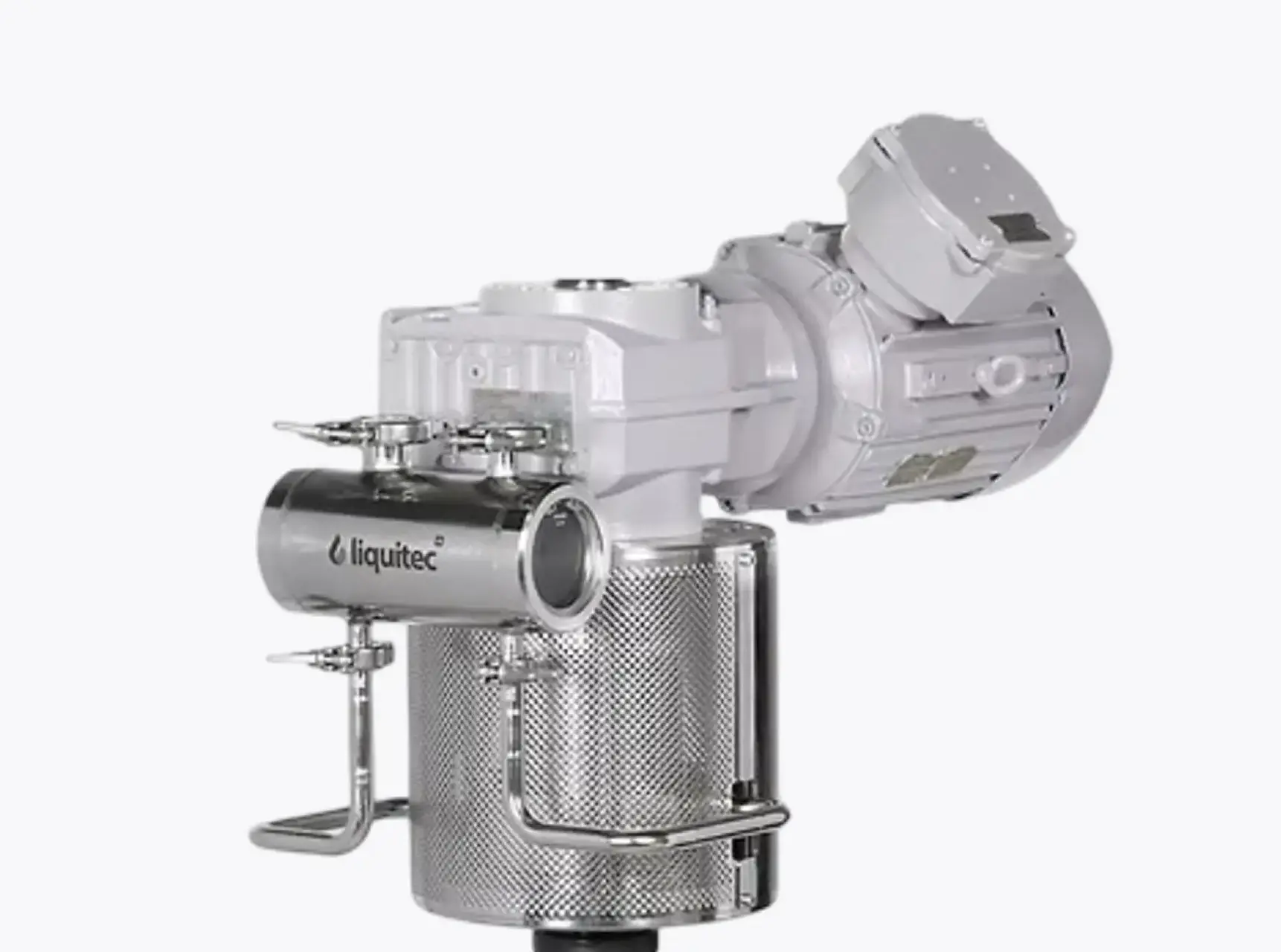
While magnetic technology represents the future of sterile mixing, specific process requirements or legacy specifications often demand the robustness of a mechanically sealed system. The bio-m® BSA (Bottom Mounted) and TSA (Top Mounted) series represent Liquitec’s engineering refinement of this classic technology.
Designed for the pharmaceutical, biotech, and food industries, these agitators utilize high-precision mechanical seals and hollow-shaft drive technology to ensure smooth operation and sterility. Whether for cell culture fermentation or complex chemical applications, the BSA and TSA lines offer a reliable, validatable solution when a physical shaft entry is required.
We have optimized the "traditional" agitator to meet "modern" Swiss quality standards: ensuring dead-leg-free vessel connections and maximum serviceability.
Advantages
Both BSA and TSA models are designed with dead-leg-free insertion flanges to ensure complete drainability and cleanability (CIP/SIP).
The bottom-mounted BSA features an optional lowering device, allowing maintenance personnel to replace the mechanical seal without removing the heavy drive unit—a significant reduction in downtime and labor costs.
The use of hollow-shaft gear motors with integrated bearings ensures a low-profile design and smooth, quiet running of the agitator shaft.
The top-mounted TSA can be configured with standard DIN 28141 flanges, making it an ideal "drop-in" high-quality replacement for existing competitor units on legacy vessels.
Full material traceability (1.4435/AISI 316L) and FDA/USP Class VI compliance for all elastomers.
Options
- BSA: Bottom-mounted for bioreactors and easy access
- TSA: Top-mounted for standard process vessels.
Questionnaire
Standardized options ranging from 25 mm to 100 mm depending on the model.
Single or double mechanical seals, cooled or uncooled, adapted to specific process media.
Stainless steel motors, ATEX (explosion-proof) versions, or standard IEC motors with painting according to customer specs.
Standard electropolished Ra < 0.8 µm or 0.6 µm; high-end finishes (Ra < 0.4 µm) available upon request.
Compatible with the full bio-m® impeller range (Rushton, Propeller, Segment, etc.).
Our bio-m® range
bio-m®
LBS
Lean Bottom System.
The Profit Center.
Don't Leave Money in the Tank.
bio-m®
BMA
Bottom Magnetic Agitator.
The Sterile Standard.
Absolute Containment, Zero Compromise.
bio-m®
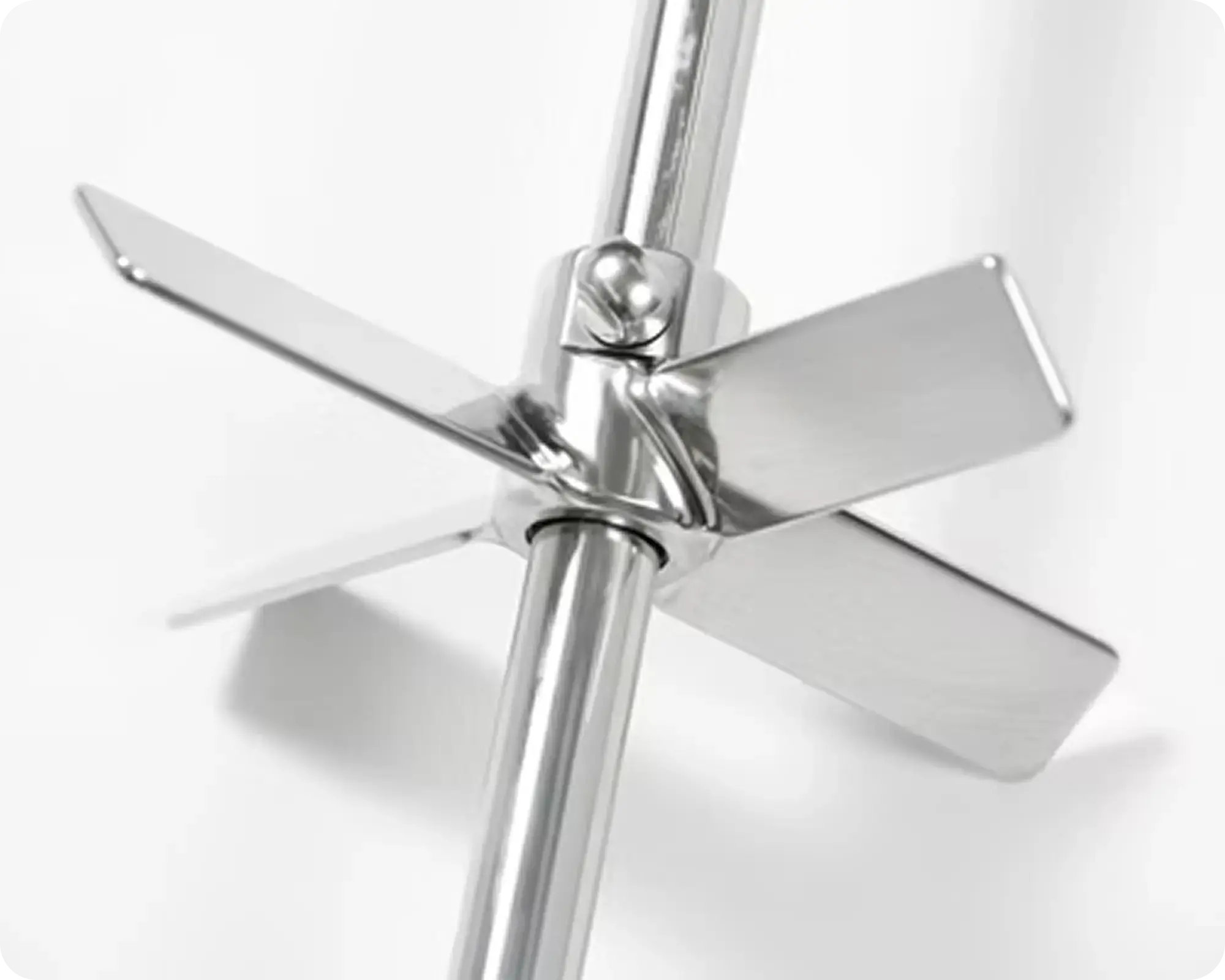
BMAF
Bottom Mounted Agitator Fermenter.
Engineered for Growth.
Your Biology, Our Physics .
bio-m®
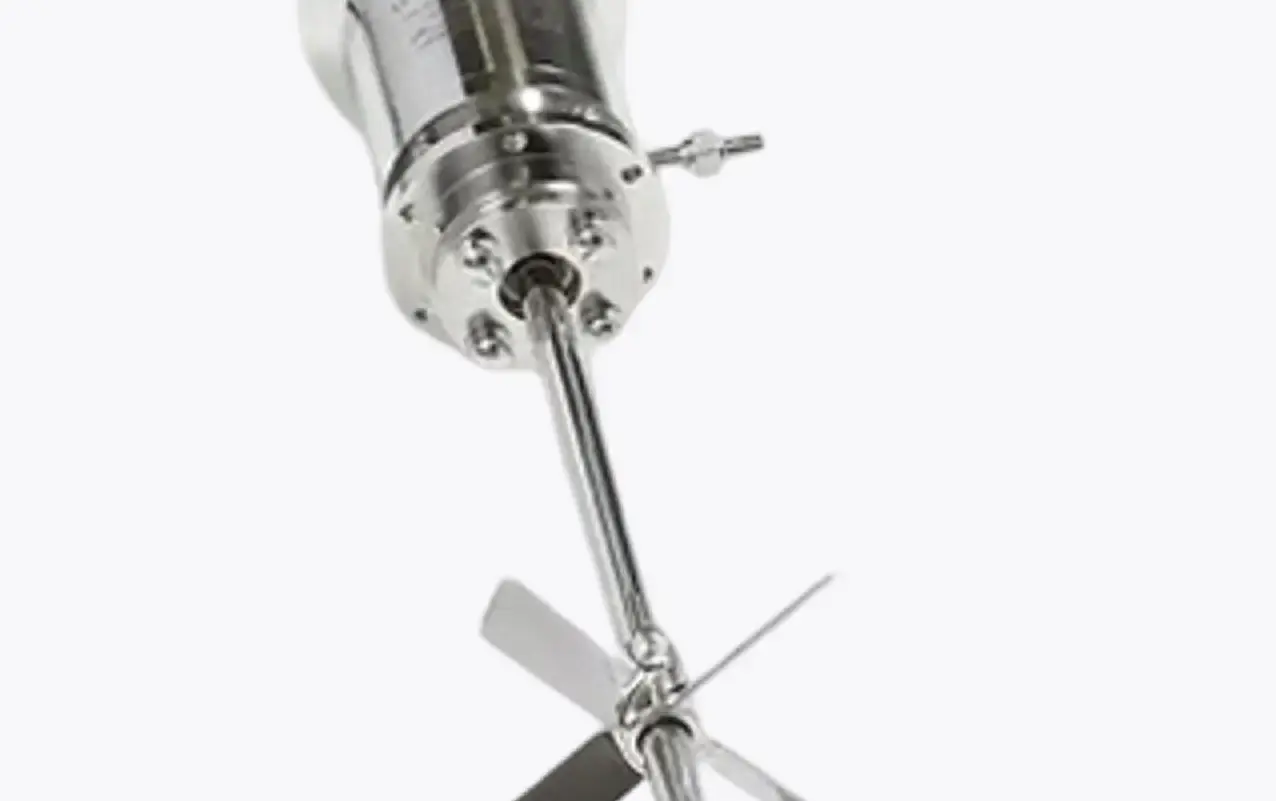
TMAi/TMAe
Top Mounted Agitators.
Solving the Geometric Puzzle.
When Bottom-Entry is Not an Option.
bio-m®
Inline Mixers
static and Dynamic
Continuous Homogeneity.
Passive Efficiency or Active Control.
bio-m®
BSA/TSA
Sealed Agitators
The Classic Standard.
Perfected.